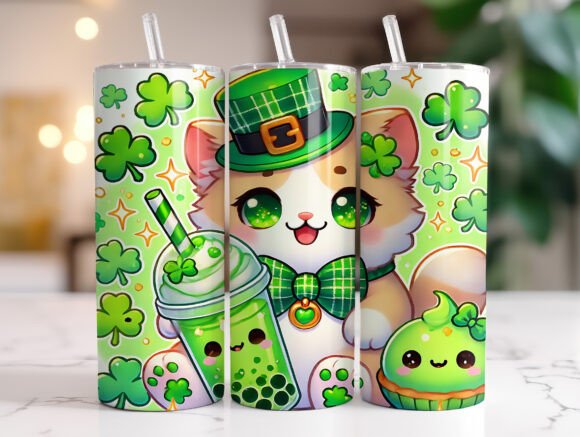
20oz St. Patrick’s Day Cat Tumbler Wrap
Let’s be real: I opened this file expecting a playful, seasonal graphic—and what landed in my inbox was something with unexpected versatility. As someone who’s stitched hundreds of holiday-themed embroidery projects—from baby onesies to boutique aprons—I approached the 20oz St. Patrick’s Day Cat Tumbler Wrap not as a tumbler graphic, but as a design asset waiting for translation into thread. And honestly? It surprised me—not because it’s flashy, but because it’s thoughtfully composed for real-world stitching.
A Design That Breathes on Fabric
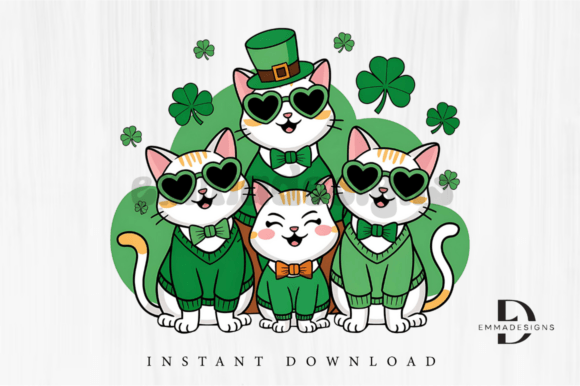
The first thing I noticed wasn’t the shamrocks or the cat’s grin—it was the negative space. The layout gives breathing room around key elements: the cat’s face sits centrally, ears clear of borders, paws relaxed, and the “St. Patrick’s Day” text curves gently without crowding. That matters. When you convert this into a machine embroidery design—say, for a linen tea towel or an organic cotton tote—the spacing translates directly to stitch clarity. No overlapping satin stitches fighting for dominance. No tiny fill-stitch clusters that’ll fuzz out after two washes. This isn’t just a printable; it’s a composition that *wants* to be embroidered.
Where It Shines (and Where It Needs Guardrails)
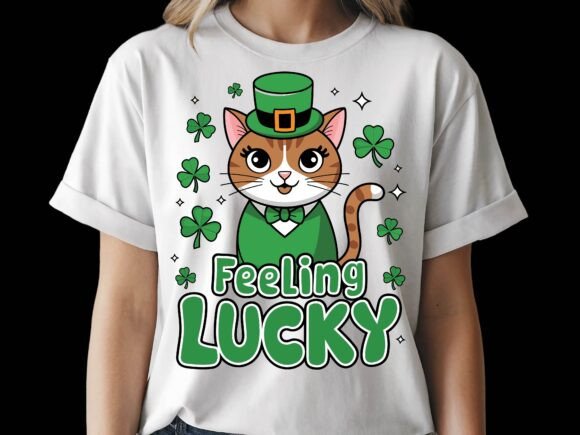
I tested a mockup of the 20oz St. Patrick’s Day Cat Tumbler Wrap on a lightweight sweatshirt front—medium-density knit, tear-away stabilizer, 40-weight polyester thread. The result? Clean, friendly, instantly recognizable. The cat reads at 3.5 inches tall, and the shamrock accents hold detail without becoming brittle. It worked beautifully as a sweatshirt embroidery, and I could easily see it as a custom embroidered patch sewn onto a denim jacket or a nursery pillow cover.
But here’s where experience kicks in: this design isn’t built for tight corners or ultra-fine detail work. If you’re planning to use it on a curved cap front, scale it down carefully—or better yet, opt for the tapered PNG version and test stitch density first. On stretchy fabric like jersey or thin baby rib, you’ll need cut-away stabilizer underneath and possibly a topping for the shamrock stems. And avoid placing it near seams or hems where tension distortion can blur those delicate paw outlines.
It also doesn’t translate well to very small hoop sizes (under 4” x 4”) without simplification. Those little clover leaves? They’re charming at full size—but shrink them below 1.25”, and you risk lost definition or excessive stitch density that gums up your needle. If you’re an Etsy seller offering personalized baby onesies, consider offering two versions: one simplified for 3” hoops, and the full wrap for larger items like kitchen towels or tote bags.
Real-Life Fit: From Craft Fair Table to Custom Gift Shop
Last week, I used a modified version of the 20oz St. Patrick’s Day Cat Tumbler Wrap on a set of linen aprons for a local café’s March pop-up. We paired it with olive green thread on natural linen—no backing visible, no fraying, just crisp, cheerful stitching. Customers didn’t just buy the apron; they paused, smiled, and asked, “Is that your original design?” That’s the quiet power of intentional composition: it reads as handmade, not mass-printed.
That same energy carries into personalized gifts. Imagine this stitched onto a soft fleece blanket for a new parent—green thread on cream fleece, gentle and warm. Or scaled slightly larger on a canvas tote for a school fundraiser: bold enough to read from across a hallway, but detailed enough to feel special up close. It bridges craft business practicality and emotional resonance—exactly what small shop owners and creative entrepreneurs need when curating holiday embroidery collections.
What You Must Check Before Stitching
- Test on scrap fabric first—especially if using textured weaves (like burlap or heavy twill) or dark backgrounds where thread contrast becomes critical.
- Review stitch density in your embroidery software. PNG files don’t include stitch data, so your digitizer (or auto-digitizing tool) must interpret line weight and shape accurately—watch for overfilled clover centers or thin outlines that may vanish.
- Confirm hoop compatibility. At 9.3″ x 8.2″, this is a large-format graphic. Not all home machines handle that natively—check whether your frame supports it, or plan for multi-hooping.
- Inspect small details at 200% zoom: the cat’s whiskers, the curve of the “S” in “St.”, and the separation between paw pads. These are easy to lose in conversion if settings aren’t dialed in.
- Try black-and-white mockups before finalizing thread colors. This design relies on shape and rhythm more than color—so it holds up beautifully in monochrome, which expands its use for minimalist brands or gender-neutral baby embroidery.
- Verify licensing before selling finished products or bundling the PNG as part of a digital embroidery file pack. Since it’s labeled as a digital download for printables, commercial embroidery rights aren’t implied—you’ll need explicit permission for resale of stitched goods or derivative design assets.
Final Thought: A Seasonal Asset With Year-Round Legs
Don’t let the “tumbler wrap” label limit your thinking. Yes, it fits perfectly on a 20oz tumbler—printed, not stitched—but its visual language works harder than that. The cat’s expressive face, the balanced layout, and the subtle Irish motif make it a strong candidate for cross-category use: as a tote bag design, a custom embroidered patch, a sweatshirt embroidery, or even a nursery decor applique design. It’s not trying to be everything—but it does one thing exceptionally well: it feels joyful, handcrafted, and intentional.
If you’re building a seasonal collection for your craft business—or just want a reliable, customer-pleasing holiday embroidery project—the 20oz St. Patrick’s Day Cat Tumbler Wrap earns its place in your design assets folder. Just remember: treat it like a sketch, not a finished blueprint. Let your embroidery judgment guide the translation from PNG to thread—and your customers will feel the difference.