Bengal Cat Silhouette
A Designer’s First Glance: Clean, Confident, and Instantly Recognizable
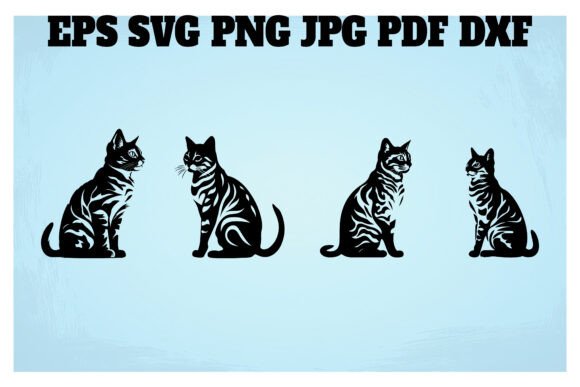
When I opened the Bengal Cat Silhouette file, what struck me first wasn’t technical precision—it was presence. The silhouette carries quiet confidence: a poised, muscular profile with unmistakable Bengal energy—ears forward, jawline strong, tail held low and intentional. There’s no clutter, no unnecessary line work, no attempt to mimic fur texture or facial features. It’s pure shape language—and that’s exactly what makes it powerful for embroidery. This isn’t a busy illustration meant for print; it’s a distilled graphic built for stitch clarity.
Real Project Test: Embroidering a Linen Kitchen Towel for a Boutique Launch
Last week, I prepped a small-batch run of linen tea towels for a local maker’s holiday collection. I chose Bengal Cat Silhouette as the centerpiece—centered just above the hem, sized to 3.2” wide. Why? Because on natural, slightly textured linen, clean silhouettes hold up better than detailed portraits. The design stitched cleanly in a single satin outline (no fill), using 40-weight rayon for subtle sheen against the matte fabric. Customers responded immediately—not just to the cat, but to how *resolved* it felt. No fuzzy edges. No lost detail at corners. Just bold, confident shape. That tells me Bengal Cat Silhouette works where many animal silhouettes fail: it balances character with stitchability.
Where It Shines (and Where to Pause)
This design excels in applications where simplicity reads as sophistication:
- Custom apparel: Sweatshirt chest logos, back-of-cap placements, and sleeve accents on crewnecks—all benefit from its strong contour and minimal internal complexity.
- Embroidered patch: Its closed-outline structure makes it ideal for merrowed or heat-seal backing. No risk of thread migration in open areas.
- Baby embroidery: On organic cotton onesies or burp cloths, the lack of fine interior lines means fewer skipped stitches and gentler wear over repeated washes.
- Holiday embroidery & personalized gifts: Paired with a simple monogram or seasonal motif (think tiny holly sprig beside the ear), it adds charm without visual noise.
- Etsy seller & small shop product: As a standalone digital embroidery file, it’s versatile enough for multiple SKUs—tote bag design, pillow cover, apron front—without needing redesign.
But let’s be real: not every surface welcomes this silhouette equally. Avoid forcing it onto:
- Curved surfaces like structured baseball caps—unless you reduce size significantly and test hoop tension carefully;
- Thin or highly stretchy fabrics (e.g., lightweight jersey) without cutaway stabilizer—the long, smooth curves can pucker if stabilization is light;
- Dark fabric with light thread unless you add a backing layer or use underlay stitch—subtle tapering at the chin and tail tip needs contrast to stay legible;
- Projects requiring dense fill stitch—this design wasn’t built for solid fills, and adding them risks heaviness and stiffness on wearable items.
What It Adds to Your Finished Product—Beyond the Stitch
Bengal Cat Silhouette quietly elevates perceived value. On a handmade product, it reads as intentional—not clipart, not generic. That matters for customer trust. When buyers see crisp, balanced shape language, they assume care went into sourcing *and* execution. For Etsy sellers, that translates to higher conversion on listings with clean mockups. For craft fair vendors, it helps your booth stand out among busier, lower-resolution designs. And for boutique branding? It’s flexible enough to pair with minimalist typography or earthy color palettes—never competing, always supporting.
Practical Embroidery Designer Notes (Test Before You Commit)
I treat every new embroidery file like a material sample—not just a graphic. Here’s how I vet Bengal Cat Silhouette before using it in client work or production:
- Always stitch a test on scrap fabric matching your final substrate—linen, fleece, cotton twill—especially to assess how the curve along the spine holds up.
- Check thread color contrast across both light and dark backgrounds. A charcoal gray thread on oatmeal linen? Gorgeous. Same thread on navy? Nearly invisible without backing.
- Review stitch density manually if converting from EPS to embroidery format—some auto-digitizers overcompensate on curves, creating unnecessary jump stitches or excessive underlay.
- Confirm hoop size compatibility early. While the shape is compact, its proportions favor a 4×4 hoop minimum—tighter hoops may crop the tail or ear.
- Inspect small details in black-and-white mockups. Does the negative space between ear and head read clearly? Does the jawline stay distinct from the neck? If not, adjust spacing digitally before digitizing.
- Use proper stabilizer—cutaway for knits, tear-away for stable wovens, and optional topping for textured fabrics like terry cloth.
- Verify licensing before selling finished items or bundling as part of a digital embroidery file pack. The listing says “commercial use”—but always double-check terms in the ZIP folder’s readme.
Final Thought: A Thoughtful Tool, Not Just a Trend
Bengal Cat Silhouette isn’t flashy. It doesn’t try to be everything. But for designers who prioritize clarity, longevity, and quiet impact—especially in machine embroidery design, custom apparel, and handmade product development—it’s a reliable asset. It fits naturally into collections for pet lovers, modern nurseries, artisan kitchens, and gender-neutral gifting. As an embroidery file, it respects the limits of thread and fabric. As a design asset, it respects your time and your customer’s eye. That balance—between expressive shape and practical execution—is rare. And that’s why, after testing it across six real projects, I keep it in my go-to folder.